|
Twenty-two years ago, HP enthusiasts met for the first time in Allschwil. Back then, there were just 10 of us gathered in my apartment for a relaxed chat about our shared passion.
Today, the meeting has taken on a whole new dimension: the apartment is far too small, casual chats have turned into presentations and individual computers have become boxes full of them. Even spouses are catered for with their own events.
This year we welcomed 20 nostalgic souls, collectors, software and hardware developers, oldies and newbies.
The location was likely be familiar to the regulars – it was “back to the roots” in the original school building, specifically the auditorium. However, it was renovated a few years ago – the chairs and tables are now suitable for adults, a PA system has been installed, and brighter ceiling lights have been fitted.
We once again opened our doors at 10 a.m., with many guests already waiting eagerly outside. The first hour is always spent enjoying happy reunions and setting-up the hardware that various people brought along – and not just the presenters. By the time we officially started at 11 a.m., almost all of us had arrived — regulars as well as, and this always makes us particularly happy, several new faces. Once again, several guests contributed to the buffet with delicious dishes from their home countries, for which we are very grateful.
This year, we began our first presentation at 11 a.m., which was surprisingly punctual. We chose Bernhard Emese to go first as he has proven himself to be a source of expertise and entertainment at past meetings and was certain to grab everyone’s attention.
After the last meeting, Bernard set himself the goal of porting an old Japanese calculator to the new ACT of the HP25A. What made this calc special was that it had no CPU and did not use machine code: all of its functionality was hardwired. Of course, there was no surviving documentation for it – but what else would you expect from one of Bernard’s projects?
Bernhard guided us through his meticulous work: a logic simulator was used to recreate the machine’s state machine, requiring every conductor track to be analysed, and memory and speed problems in the ACT had to be overcome. But we know our Bernhard by now: good things take time, but he finally presented us with his simulator on the HP25A new ACT.
The NP34 was developed in 2023 by Chris Chung to emulate the HP-34, 37 and 38 Spice LED calculators. His namesake, Chris Morris introduced us to this little gem, which is powered by a Texas Instruments MSP430 microcontroller running off a single CR2032 button cell but, while it definitely appeals to HP enthusiasts, it is not for the faint-hearted when it comes to ease of use. The keyboard is significantly smaller than on the old Spice calculators, consisting of micro-switches only (but no less crisp in their pressure point) with the key legends printed on the circuit board itself. Unfortunately, this means they are fixed for the HP34, which makes switching to the HP37/38 or, more recently, to the 31/32/33 and Woodstock calculators somewhat pointless. The only remedy is to use homemade printed overlays.
To be honest, I wasn't particularly looking forward to Pascal Dagornet's presentation on HP71 Forth and assembler. Years ago, I used to program in C on a PC, but Forth and especially assembler are an incomprehensible universe to me as a collector.
But after just a few minutes, I realised that I had assumed the content would be completely different. Pascal's intention was not to teach us assembler code, but rather to explain the relationship between HP71 Forth and the HP41.
Since the HP71B Forth & AMS module is not exactly cheap, Pascal suggested a MultiMod or EMU71 as a more affordable alternative. Pascal’s presentation was peppered with tips and clear step-by-step instructions for us newbies.
After the first four presentations, it was time for a lunch break: Hans-Peter’s girlfriend baked fantastic cakes and made countless sandwiches. Coffee and cookies were of course just as essential as further stimulating conversations.
At 2:30 p.m., everyone gathered outside in the schoolyard for another highlight, the traditional photo shoot. This year, the beautiful autumn leaves were in competition with the 20 beaming faces.!
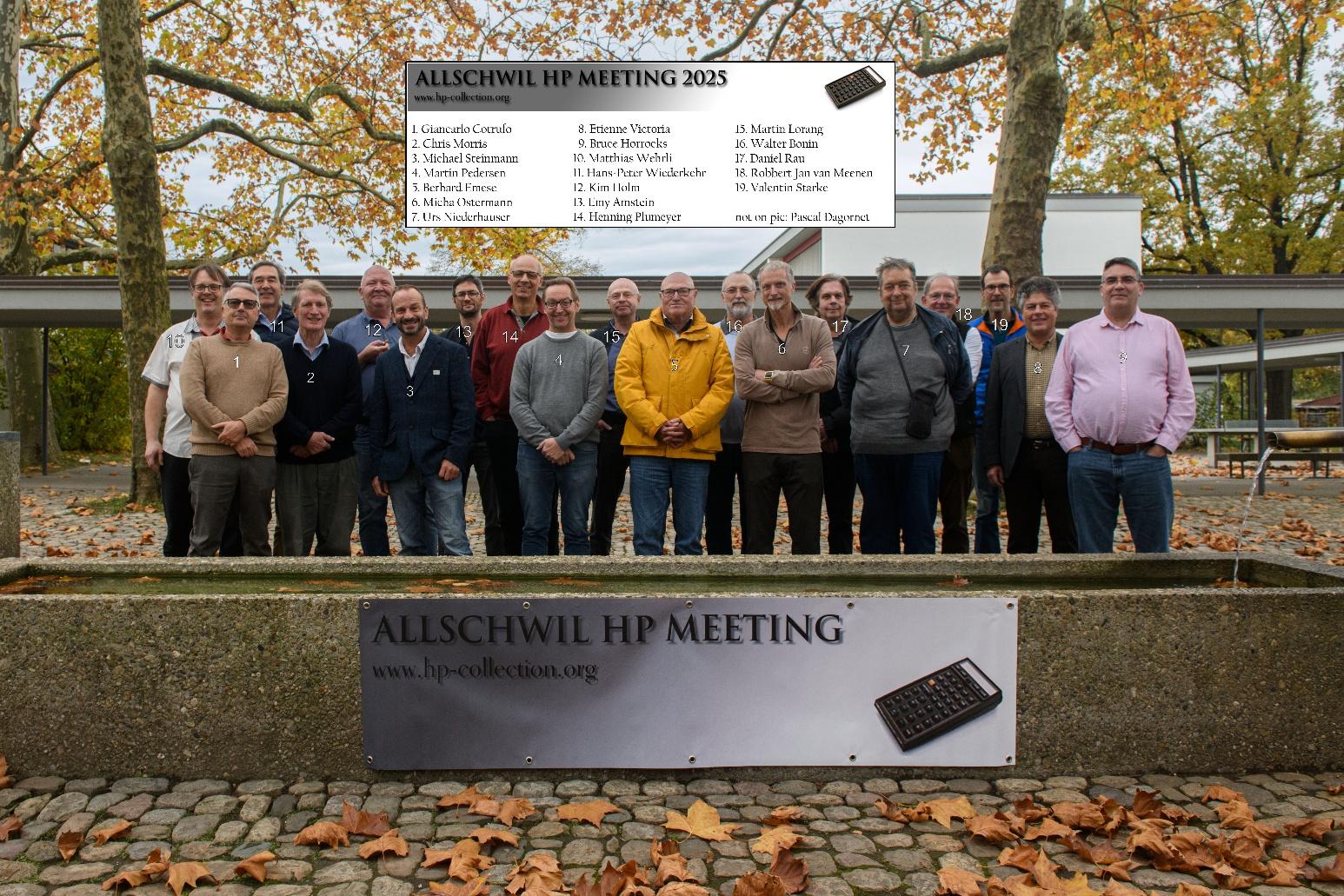
The next speaker, Etienne Victoria, introduced us to the Tulip4041, which Meindert Kuipers had completed just in time. Unfortunately, Meindert was unable to attend this meeting, but Etienne easily managed to get the participants interested in the little flower. In addition to a large memory for ROM images, it offers a QROM emulator for MLDL and HEPAX, user memory, an emulator for HP-IL, wand and IR module. Furthermore, the HP41 bus can be traced and an HP-IL scope emulated. The amazing thing about it is that the device is only about the size of an HP-IL module, complete with a 3D-printed case decorated with a tulip. The incorporated USB-C, microSD slot and IR diode enable all kinds of data exchange.
Walter Bonin, attending an Allschwil HP meeting for the fourth time, presented the further development of the WP43, a software-based scientific calculator that runs on SwissMicros' DM42 hardware.
Walter’s talk neatly moved the focus onto the high-end devices available to the HP community, continued by Robbert Jan van Meenen who introduced us to the further development of the C47 and the R47. These are alternative, open-source scientific calculators that can installed on the DM42 from SwissMicros, replacing the version of Free42 that comes built-in.
The C47 software offers a very extensive range of functions with good user control in that menus and key assignments can be easily customised. However the increase in functionality (over the DM42) means that although the keycap functions were able to be kept the same, the shifted functions have had to be changed and a keyboard overlay is needed. The R47 uses the same underlying software as the C47 and therefore has the same functionality on offer, but has the advantage that it is an official product from SwissMicros with a dedicated keyboard meaning that no overlays are required.
Incidentally, we learnt that the number 47 was chosen as it is the lowest prime number that HP has not previously used.
The C47/R47 community is taking a new approach to the manual: instead of a 1000-page manual, the manual consists of dozens of smaller PDF files that are generated from a database and can be easily amended while changes are being made regularly.
The ensuing discussion about “Which is the best calculator?” resembled a sales pitch at times, but ultimately showed that there is no such thing as THE perfect calculator and that users must decide for themselves which of the three high-end calculators is their favourite: the DM42(n), WP43, or C47/R47.
The conference presentations were a great success, less so our video equipment which has let us down and it is unclear whether any the presentations will find their way onto our YouTube channel. We will work on this before the next meeting so that guests who are unable to attend can also get an impression of the variety in the future.
This year, we decided to use the proceeds from the voluntary coffee fund to give back you the attendees: for the next meeting, we have put together a equipment box of useful items so that you can travel with less luggage: cable reels, power strips with type F (Schuko) sockets, additional adapters, a PC notebook for presentations, a laser pointer and much more.
We have particularly fond memories of the countless kind words and thanks we received from many guests for organising the meeting. This year, I noticed this much more intensely.
Thank you all for coming in such large numbers and making the meeting what it should be: an exchange among like-minded people filled with heartfelt conversations and interesting discussions.
Matthias Wehrli
Hans-Peter Wiederkehr
Original meeting review (PDF)
| 


