|
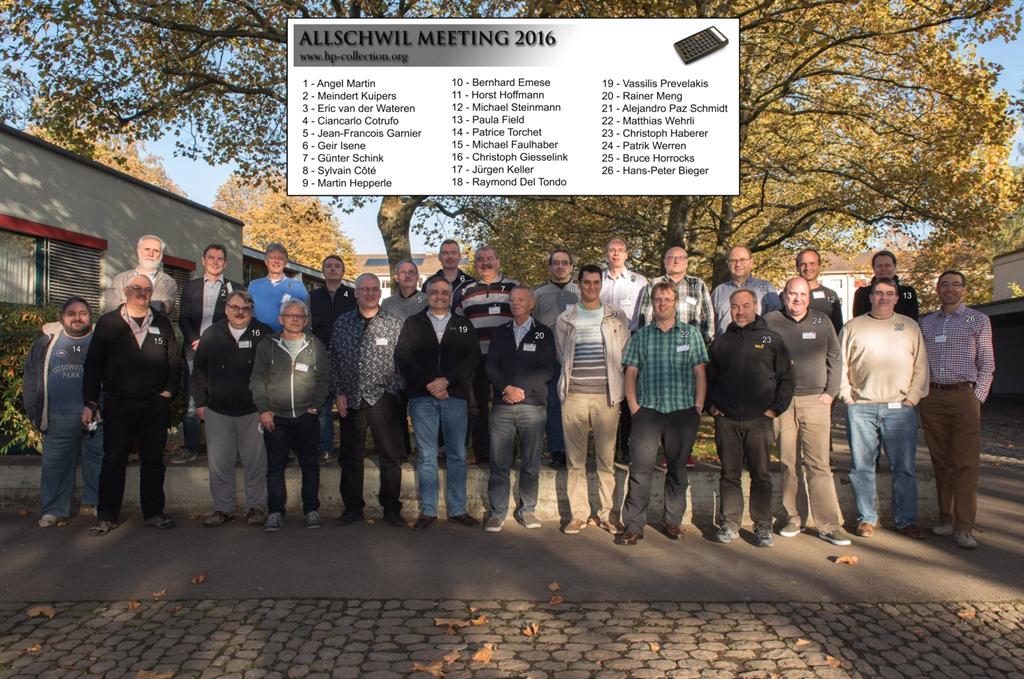
Once again, beautiful Autumn weather greeted the many freaks, nerds and enthusiasts who congregated in Basel (or the ‘Rheinknie’, as we say in German) for the 2016 Allschwil meeting.
It has become traditional to meet at the host’s house before the meeting, a tradition that – as the host – I wanted to follow for this year. This allows everyone to catch-up with each other’s news and events, as well as look through my HP-Collection. The collection is extensive and many of the machines are rare, even unique, as well as historic, so it’s nice that enthusiasts can get to see them occasionally and not have them ‘locked away’ in a safe all of the time.
This year, 25 people (from Canada, England, Norway, the Netherlands, Germany, France, Italy and of course Switzerland registered) the highest number yet. While it’s great that so many people want to attend, the collection room proved to be a little small. I shall see what can be done next time.
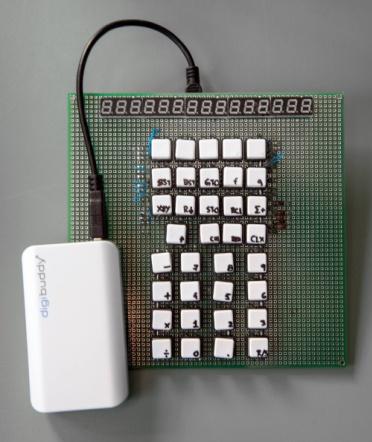
The first presenter was Alejandro Paz Schmidt who presented his own pocket calculator. Developed over the last few years, it is a Woodstock replica running on his own hardware platform (screen and keys). The hardware is more prototype than fully designed at the moment, but the emulator works. In a one hour presentation he took us (briefly) through the whole development process. It’s unbelievable what some people can manage to create.
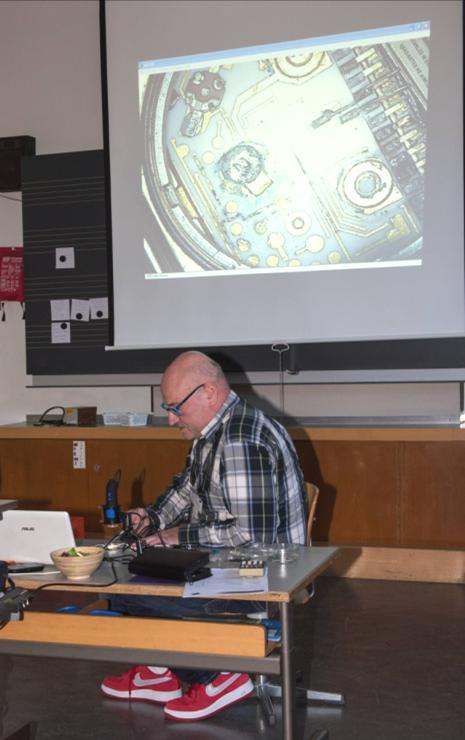
Next was Bernhard Emese. He started with a test: he showed us a converted HP-25 and asked what other calculator was being emulated on it? To make things harder, the key caps of the original donor machine do not help, so the only way to succeed is to know specific tell-tale operation sequences that differ between the various Woodstock models, and run them to see. Perhaps unsurprisingly, no one worked out that it was actually running an emulation of an HP-70. The ROM came from an HP-70 that I loaned Bernhard, and I know from our email exchanges that extracting the ROM was a serious headache, taking several months.
Bernhard then moved onto the second part of his talk which was a description of his experiences producing a replica main board for the HP-01 watch. Over a half-hour period, Bernhard took apart a defective HP-01 which he had brought along for the purpose, removed the circuit board and replaced it with his kit alternative. Fortunately it all worked and we were able to see the watch display light up again. The only unfortunate point is that the kit is not cheap, costing €300, which rather limits it to real professionals.
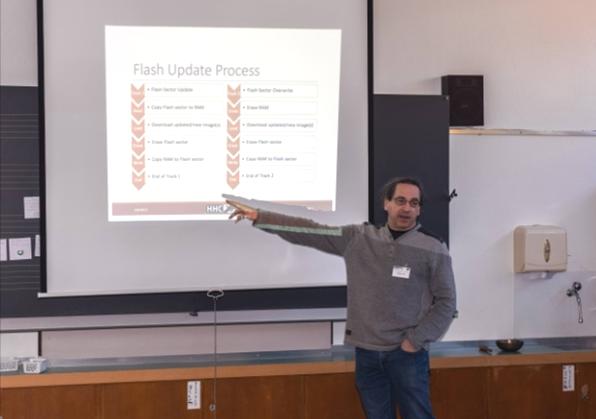
This year, for the first time we were able to welcome a visitor from the Americas – Sylvain Côté. You may have noticed that Monty Dalrymple has produced a hardware modification for the HP-41 that turns any model into an ‘HP-41CL’ which the nice feature that any HP-41 expansion ROM can be loaded into flash and then accessed. Well, Sylvain has produced an HP-41CL ROM Database which simplifies the effort needed to make any combination of ROMs work together. Sylvain has made his database publicly available.
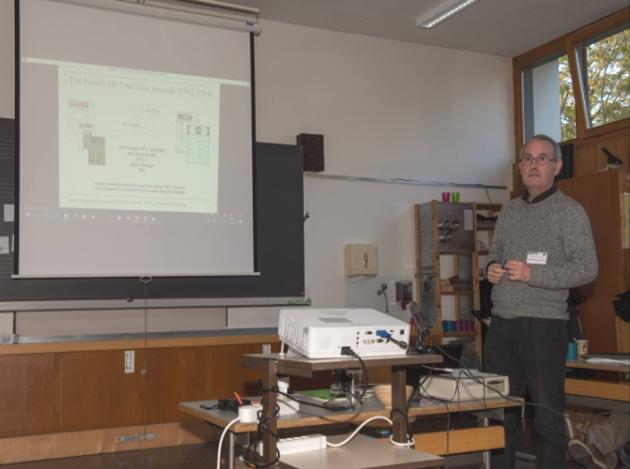
Next up was Jean-François Garnier, one of the founders of the Allschwil meetings, who gave three presentations: "How to create LIF disks" using the PIL-box that he, previously, also developed. All data from the disk’s tracks (whether ‘extra’ tracks or unwritten tracks) is extracted by his ‘ILvlif’ utility and saved as a hard disk file.
"Speed optimisation of the HP-IL loop". Jean-François ‘distrusted’ the figure originally quoted by HP and set about measuring actual speeds in actual conditions. Numerous measurements were taken with varying numbers and types of device in the loop.
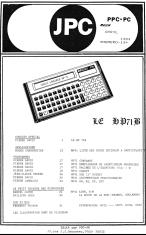
Finally, Jean-François introduced us to the French PPC Journal and his plans to continue the scanning effort so that they might be made available digitally.
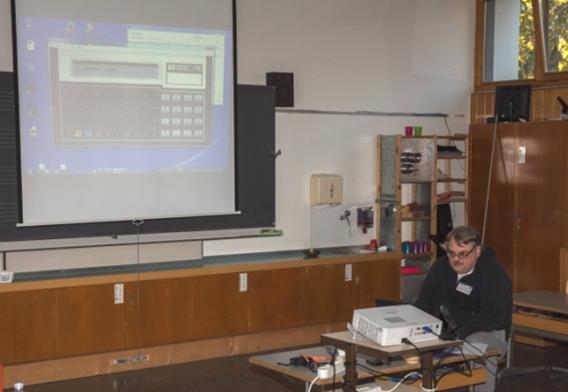
Following on was Christoph Giesselink who talked about one of his long-term projects – his popular Saturn emulators. So far they have lacked support for red-eye and sound but this will soon change after 10 years of on and off work, having realised that the solution for the timing issue for the red-eye also solves the timing for sound as well.
He also briefly showed the first HP-71A emulator running ROM 0AAAA which Sylvain Côté and Jean-Francois Garnier had only just extracted 15 minutes before from one of my museum treasures!
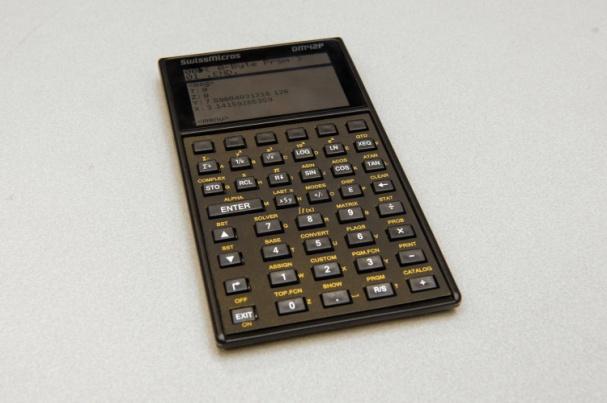
This was the last of the official presentations, but we were treated to a presentation by Michael Steinmann. He and a Czech programmer are developing a new model to be called the DM42P which is a graphics-capable successor to the HP-42S. As he described the technical details, a functioning prototype was passed around which showed it is very nearly complete. He gave us some insight into the development history of the machine, the current status, the parts still to be finalised for manufacturing. Michael hopes that sales will start in the first half of 2017.
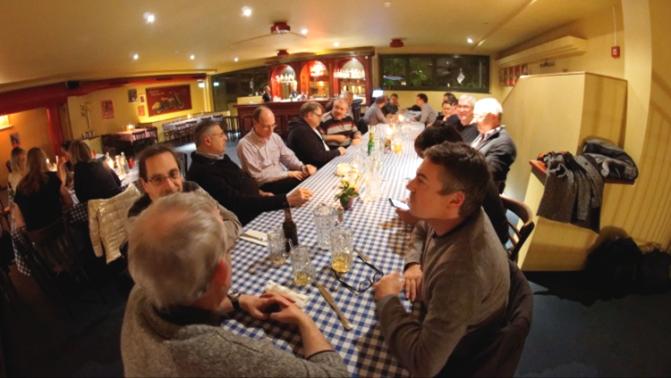
After 6 hours of extremely stimulating but exhausting presentations feeding the mind it was time to feed the body! Traditionally the Allschwil meeting goes to a nearby American restaurant in the evening. Swiss restaurants are never cheap so if you hadn’t spent all your money buying an upgrade or a machine for your collection earlier then it was going to get used now. However the portions are large so no one went home hungry.
I would like to thank all the participants for making this such a successful event. I was really looking forward to seeing people who had made the effort to come such long distances. I enjoyed learning and hearing such a lot, both from the presentations and the general conversations. The next meeting is scheduled for 2018 and I need to start thinking about room sizes, restaurant sizes etc if it continues to grow as it has done.
Whatever happens, I look forward to seeing you all again in 2018.

PS: Thanks to Bruce Horrocks for the english translation of this review!
Original meeting review (PDF)
| 


